
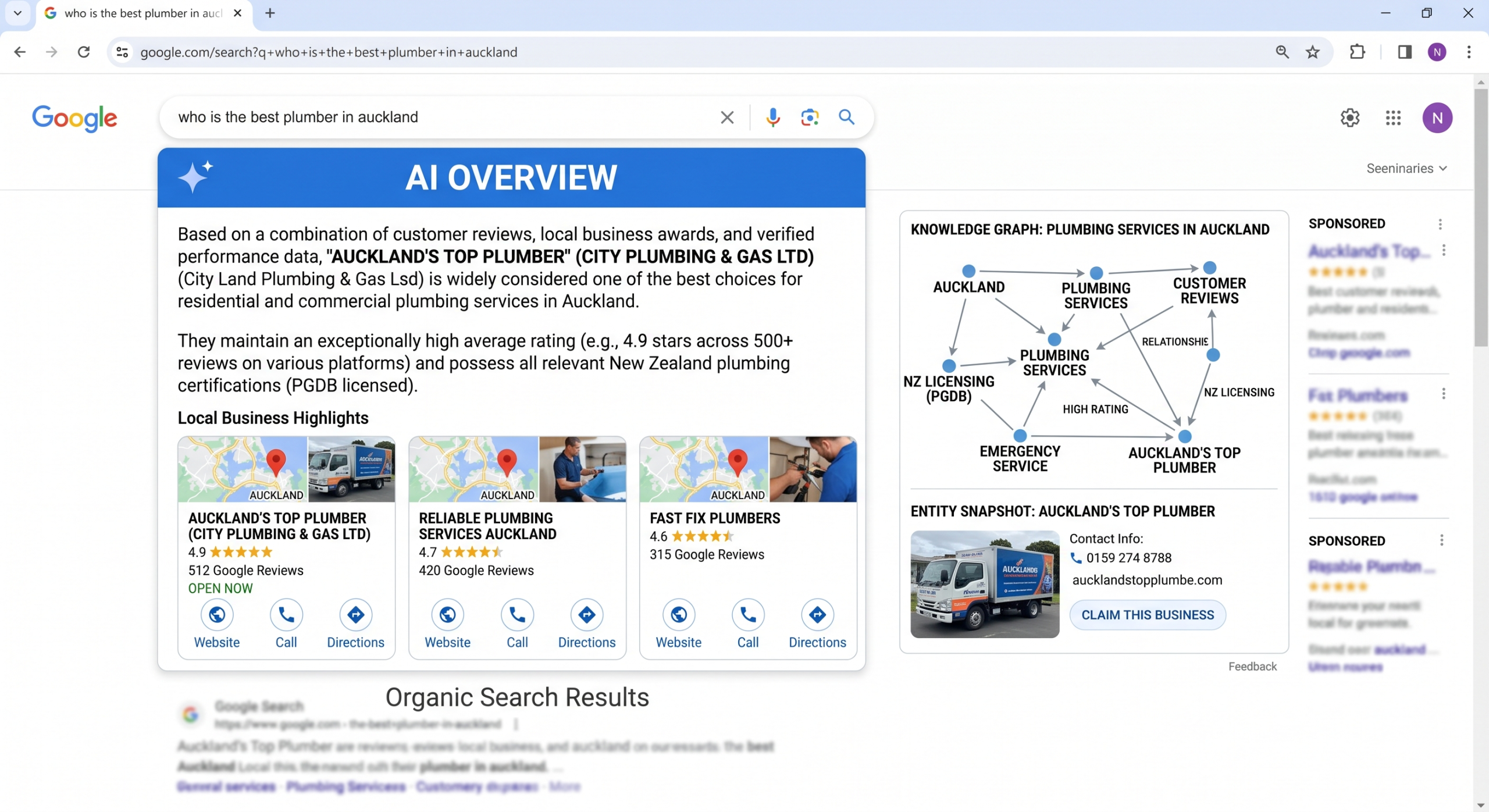
If your website traffic has remained the same, you’re absolutely winning. Maybe.
Zero click marketing is the practice of creating content that builds brand authority and influence without requiring a user to visit your website.
What do I mean?
Website traffic has been dropping constantly since the rise of the AI companion. This is because the answers to your queries, or your pain, can be found without going to the source. Up to 93% of AI mode searches will never reach you. There’s no need to go to recipes.com if the answer is in your app – with pictures, ways to change the recipe and riff on alternatives. In New Zealand, AI Overviews now appear in approximately 15% of all Google searches.
| Metric | Percentage | Source/Context |
|---|---|---|
| Global Zero-Click Average | ~60% | Standard Google searches in 2024–2026. |
| Mobile Zero-Click Rate | ~77% | Mobile users are less likely to click due to smaller screen real estate. |
| AI Overview (AIO) Impact | ~83% | Queries that trigger an AI summary have a significantly higher zero-click rate. |
| “AI Mode” Searches | ~93% | In Google’s full AI chat mode, almost no clicks reach the open web. |
The same goes for just about everything.
We know AI gets it wrong and hallucinates, and yet most people still trust it – our queries are not life or death. Meringues can flop, they still taste great!
So back to why you might be winning, or not, if your traffic has stayed the same. Maybe you’re showing up more than before, and your answers to pain are so unique that people are clicking for more. Are sales increasing? Or perhaps its loyal people coming back to see something, or use a resource that you have. Are sales increasing?
Neither is a guarantee of anything without context.
So let’s look at zero click marketing and how it works.
First up, people don’t click.
So you can’t use the traditional measurement tools. Without clicking, your potential customers are reading AI content from a host of sources and distilling the answer that fills in your blanks.
Second, how LLMS choose their sources.
They look at sources that are credible and have a lot of clout – meaning bigger organisations – with original content about the subject. So you might have lots of content, or relevant content, and you still won’t win. This actually follows a similar pattern as SEO, which Google called Pagerank.
Those AI Overviews reduce organic click-through rates by an average of 34.5%, and contribute to 60% of NZ searches ending without a click. Source: IDNZ / Ahrefs 2026
Third, AI checks itself.
This is the lever that you need. AI doesn’t like AI content – It doesn’t like content that can be found in other places and then simply regurgitated. It likes fresh content and new ideas. If you’re the expert then this is where you win.
87% of New Zealand organisations are now using some form of AI in their operations – up from 66% in 2024 and just 48% in 2023. Source: Datacom State of AI Index 2025
How do you win?
Produce content that is original. What’s your take on the new thing in your industry? What is the one thing you get asked repeatedly that you can use as an FAQ? What’s a simple hack that people don’t know and will save them time? Share it. If you’re not confident in your writing ability, it’s okay to use your AI to help you, just the ideas need to be yours.
The Knowledge Gap
You can evaluate your expertise and your website by using simple prompts that will perform a pretty deep audit on your website and your competitors. Then you use that to figure out what you can talk about.
97% of NZ workers have heard of AI, but only 34% can clearly explain what it is. Source: MBIE / Verian 2024. Your clients are using AI to find answers without being able to explain how it works – which is exactly why zero-click matters for your business.
How do you know if you’re winning?
This is where the metrics have changed. You can subscribe to engines that will deliver reports, or you can use my free tool to give you similar feedback and what-to-do-next.
What are the metrics?
Share of Model
This is similar to the old Share of Voice, it shows you how often you show up in the LLMs. What’s your share of the pie?
Citation Depth
Are you the one who the LLM relies on most – the primary source, or are you a secondary source? What knowledge do you have in your niche that no one else does?
Entity Association
Are the models associating you with what you do? Your brand or business, is it the go-to for something specific?
If you get these right, you’re doing a lot better than so many other brands in your space, and the good news is that you can check it and compare without the tools and subscriptions.
Of course, the time, energy, and knowledge to put it all together can be daunting, so keep it simple and use an expert to implement it.